Rethinking Commercial Waste: How Smarter Waste Management Drives Operational Efficiency and ESG Performance
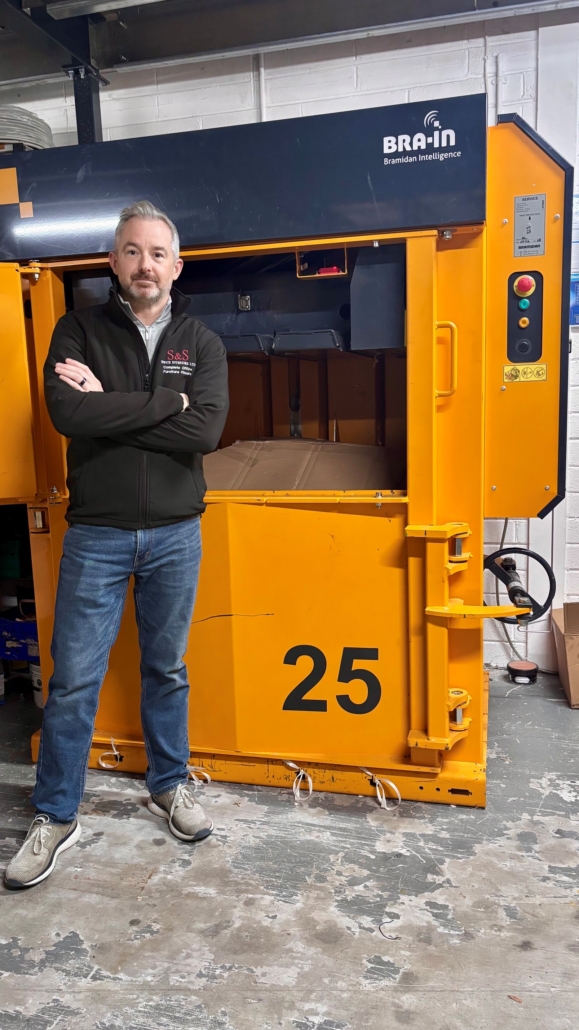
Discover how S & S are using new modern waste handling solutions, including balers and compactors to help our commercial facilities cut waste volume, streamline internal workflows, and advance corporate ESG targets.
The modern commercial environment is evolving rapidly. Whether managing day-to-day facility operations, overseeing warehouse logistics, or coordinating large-scale workplace fit-outs, expectations around sustainability have moved past high-level aspirations. Today, corporate leaders, procurement teams, and facility managers face stringent Environmental, Social, and Governance (ESG) standards and an urgent need to account for operational greenhouse gas emissions .
At S & S Office Interiors Ltd, we believe that genuine sustainability starts with practical, on-the-ground operational decisions. One of the most critical—yet frequently overlooked—areas ripe for immediate improvement is commercial waste handling.
By replacing uncompressed, reactive waste disposal with structured solutions like commercial balers and compactors, businesses can simultaneously cut operational friction and support meaningful environmental objectives.
The True Cost of Unmanaged Commercial Waste
In dynamic commercial settings—particularly during the delivery, assembly, and staging of commercial office furniture—protective transit packaging accumulates at a staggering pace. A standard workplace refresh involving dozens of ergonomic task chairs, height-adjustable desks, acoustic screens, and modular storage units leaves behind substantial volumes of:
-
Heavy-duty corrugated cardboard cartons and corner protectors
-
Low-density polyethylene (LDPE) shrink-wrap and stretch film
-
Pallet strapping and protective packaging inlays
When left loose or discarded into standard open skips, these materials present immediate operational and financial headaches. A skip filled with uncompressed cardboard boxes is largely transporting empty air. Facilities end up paying premium disposal fees simply because bulky packaging occupies massive physical volume before reaching its actual weight threshold.
Beyond hauling costs, loose packaging rapidly encroaches on loading docks, blocks walkways, creates fire and slip hazards, and forces staff to spend hours manually slicing and flattening boxes instead of focusing on core operational tasks.
The Solution: The Mechanics of Balers and Compactors
Industrial balers and waste compactors tackle packaging waste at the source. Rather than tossing loose materials into bins, items are loaded into dedicated machinery that applies mechanical pressure to compress the material into dense, stackable, and uniform bundles (bales) or enclosed compaction units.
Integrating this equipment into commercial and warehouse operations unlocks three critical operational benefits:
1. Drastic Volume Reduction (Up to 90%)
Loose cardboard cartons and expansive plastic films are reduced to a fraction of their original footprint. For instance, a mountain of loose cardboard that would fill multiple 1,100-litre wheelie bins can typically be compacted into a single, high-density 200–400 kg bale. This radical volume reduction immediately eliminates unsightly overflow, keeps storage yards immaculate, and directly curtails collection frequency.
2. Optimised Facility and Real Estate Space
Commercial real estate is expensive, and floor space dedicated to storing loose waste is unproductive capital. By replacing multiple wheelie bins or large open skips with a compact footprint baler, facilities reclaim valuable square footage. Loading bays remain clear for incoming freight, transit corridors stay unobstructed, and yard spaces can be repurposed for productive logistics or vehicle parking.
3. Streamlined Internal Workflows and Workplace Safety
Manual waste processing—such as warehouse operatives or fit-out teams spending hours breaking down heavy packaging with utility knives—is inefficient and carries a notable risk of repetitive strain or cut injuries. With a dedicated baler:
-
Operatives feed whole, intact boxes directly into the chamber.
-
Packaging is contained immediately at point-of-use rather than left scattered across assembly zones.
-
The working environment remains clean, uncluttered, and compliant with occupational health and safety standards.
Connecting Waste Compaction to ESG and Carbon Footprint
How does a mechanical baler translate to measurable environmental performance? The connection lies directly within transportation logistics, raw material recovery, and Scope 3 emissions reporting.
Alan Spain (Managing Director) Along side the new Commercial Bailer